.png)
AI Is No Longer a Race for Better Models—It's a Race to Redesign Business.
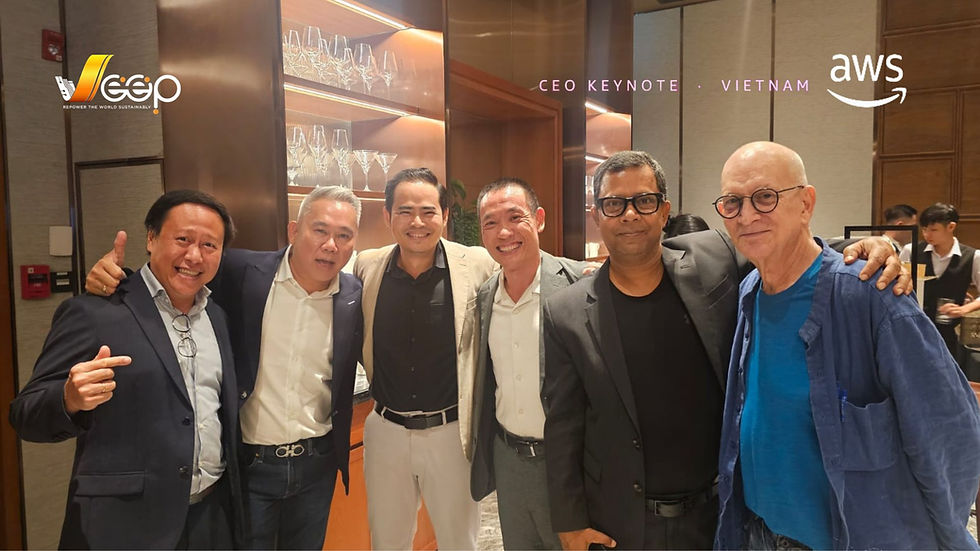
Recently, Mr. Viet Nguyen, Chairman & CEO of VEEP, attended the sharing session "AI Journey: From Risk to Returns" presented by Varun Dayal, Head of AI, AWS ASEAN. The session provided valuable insights into the latest AI trends and how organizations are moving beyond experimentation to generate measurable business value.
One of the most compelling messages was the paradox of today's AI landscape: while AI capabilities continue to advance at an unprecedented pace and companies are investing hundreds of billions of dollars in AI, the majority of AI initiatives still struggle to deliver meaningful return on investment or scale beyond pilot projects.
According to AWS, the challenge is not the AI models themselves—it is how organizations implement them. Many businesses focus on isolated applications such as chatbots, document summarization, or AI assistants. While these solutions improve individual productivity, they rarely transform business performance.
The real source of ROI comes from redesigning enterprise workflows on top of a unified AI platform—one that connects data, enterprise systems, and AI agents to automate complex business processes that directly impact revenue, operational efficiency, and competitiveness.
The session also highlighted the emergence of Agentic AI—a new generation of AI capable of planning, reasoning, collaborating through multiple agents, and executing higher-level objectives with enterprise context. Rather than simply responding to prompts, Agentic AI is becoming an active participant in business operations, marking the next stage of digital transformation.
For VEEP, these insights strongly reinforce the direction we have been pursuing. From the beginning, our vision has extended beyond applying AI for data analysis or reporting. We are building an AIoT-powered energy management platform that integrates real-time operational data, analyzes energy consumption patterns, supports intelligent decision-making, and continuously optimizes the performance of buildings, industrial facilities, and cold-chain infrastructure.
We believe that in the energy sector, AI creates value not by delivering slightly better predictions, but by fundamentally transforming how facilities operate—reducing energy waste, lowering operating costs, minimizing carbon emissions, and enabling organizations to achieve their ESG and sustainability goals.
Another key takeaway from the session was that organizations leading the AI transformation share several common characteristics: they focus on workflows that directly impact business performance, build AI platforms with enterprise context, develop AI capabilities across the organization, define clear long-term ROI objectives, and, most importantly, drive transformation through strong CEO sponsorship.
These lessons provide valuable guidance as VEEP continues to advance its AIoT solutions, helping businesses optimize energy consumption while accelerating both digital transformation and the transition toward a low-carbon future.
We sincerely thank AWS ASEAN and Varun Dayal for an inspiring and thought-provoking session. At VEEP, we believe the question is no longer whether AI can create value—the real question is how quickly organizations can redesign their businesses around it.